HEPA grades explained: H13, H12 and "True HEPA"
The filter is the part of an air purifier that does the actual cleaning, so it's natural to want a good one. The difficulty is that filter labels are confusing, and it isn't your fault if they've left you unsure. One box says H13, the next says True HEPA, and a third uses a name the brand came up with itself. Some of those words point to a published standard and some don't. Telling them apart only takes a few minutes, and it may surprise you that the grade, important as it sounds, isn't the first thing to check.
Published November 2026
What a HEPA filter promises
HEPA is short for high efficiency particulate air, and it names a kind of pleated filter that traps particles as air is pushed through it. The US EPA gives the usual definition, in which a HEPA filter is defined as removing at least 99.97% of dust, pollen, mould, bacteria and other airborne particles with a size of 0.3 microns.
That 0.3 micron figure is easy to misread as the smallest thing the filter can catch, and it’s actually better news than that. The same EPA page explains that 0.3 microns is the worst case, the size that slips through most easily. Particles that are larger or smaller than that are trapped with even higher efficiency.
H13 is a tested class, and H12 isn’t one
The grades with a letter and a number come from a European standard called EN 1822. It tests each filter at the particle size that particular filter finds hardest to catch, which for most filters is close to 0.3 microns, and then places it in a class. The classes run E10 to E12, then H13 and H14, then U15 to U17.
H13 is the first class in the HEPA group, and to earn it a filter has to stop 99.95% of particles at that hardest size. H14 is the next step up, at 99.995%.
If you’ve spotted that 99.95% is a touch lower than the 99.97% in the usual definition, please don’t read that as H13 being the weaker promise. The two figures come from different tests, so one can’t be ranked against the other.
H12 is missing from the list of classes altogether. The class just below H13 is E12, set at 99.5%, and it belongs to the group underneath HEPA. So a filter sold as “H12” is using a name the current standard doesn’t have, and the sensible way to read it is as one step below H13. That one step is bigger than it looks, because at its hardest particle size an H13 filter lets through 0.05% of particles and an E12 filter lets through 0.5%, which is ten times as much.
“True HEPA” and “HEPA-type” are words on a label
“True HEPA” isn’t one of the classes in the standard. Brands use it to say the filter meets the usual HEPA definition, and most print the 99.97% figure beside it. What’s missing is a class, so the words don’t tie the filter to one named test.
“HEPA-type” and “HEPA-style” promise less again. The wording says the filter is like a HEPA filter without tying it to any number at all, so we’d give those the least weight of anything you might read on a box.
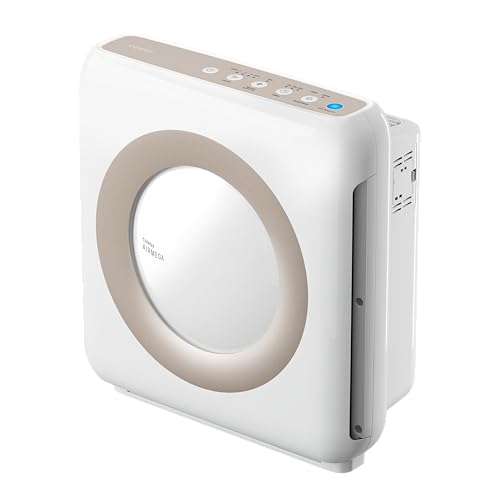
Then there are the brand names, such as Coway’s GreenHEPA and the Philips NanoProtect HEPA. These are trade names for a brand’s own filter, and they sit alongside the classes without being one of them.
The labels on the purifiers we list
It may help to know how common each kind of label is. Only about a quarter of the purifiers in our list print a grade, and every one of those is a 13, written as H13 or HEPA-13. The others that name a filter say True HEPA, use a brand name with HEPA in it, or say HEPA and nothing more. None is sold as H12 or HEPA-type.
We print the wording exactly as each spec sheet gives it and never upgrade it, so a filter described as True HEPA stays True HEPA in our tables.
A high grade can’t make a small purifier big
The grade tells you how much a filter traps on a single pass. What happens in your room depends just as much on how much air gets that pass each hour, and two purifiers from the same brand show this nicely.
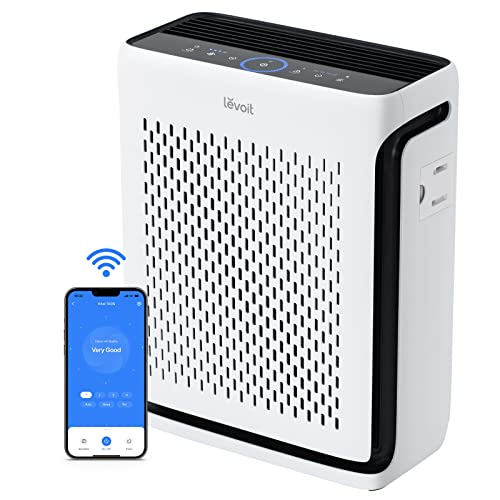
The Levoit Core Mini has a filter labelled H13 True HEPA, and no purifier in our list claims a higher grade. It delivers 55 m³ of clean air an hour. We size a purifier by the room it can clean five times an hour, and for the Core Mini that’s a 4 m² room, because the fan behind that very good filter is a small one.
The Levoit Core 600S is at the other end. Its filter is labelled True HEPA with no class number, and it delivers 711 m³ of clean air an hour, which by the same rule is enough for a 59 m² room. Going on the filter wording alone, the Core Mini would look like the better buy, and yet for any ordinary room it’s far too small.
So size the purifier first, and our explainer on what CADR means shows how. When two purifiers are both big enough for your room, the grade makes a sensible tie-breaker.
Smells need a carbon layer
A HEPA filter is built for particles, and smells aren’t particles. They’re gases, and they pass straight through a particle filter. The EPA’s guide to air cleaners notes that most filters are designed to filter either particles or gases, which is why many purifiers carry two filters. Smoke is a mix of the two, particles and gases together, so for smoke both layers matter.
Activated carbon is the usual second layer, and here the amount counts. The same guide adds that carbon filters can be effective, provided there’s a large amount of material in the filter. The carbon is what does the work, so a thin sheet of it has much less to give than a thick bed, and the words “carbon filter” on a box don’t tell you which of the two you’re getting.
Most of the purifiers we list name an activated carbon layer. If cooking smells or smoke are your reason for buying, check the “Carbon layer for smells” row on the air purifiers page before you choose.
Reading the label in the shop
If you’d like the short version to take shopping with you, it comes down to three things.
- A class such as H13 names the test behind the figure, so it tells you a little more than “True HEPA” does. “HEPA-type” tells you the least.
- A good filter in a small machine still cleans a small room, so size the purifier before you compare filters.
- For smells, look for a carbon layer as well as the particle filter.
One last thing should be said plainly. A purifier cleans the air in a room, and it doesn’t treat allergies or asthma, so please follow your doctor’s advice on those.