Top budget air purifiers under $300
You don't need to spend a lot to get a purifier that does its main job well, because the main job is a simple one, which is drawing the room's air through a fine filter again and again. What a lower price usually means is less air moved each hour, and so a smaller room, and that's a perfectly good trade if your room is small to begin with. So we've looked only at our two cheapest price bands, under $150 and $150 to $300, and chosen on clean air for the money before anything else. The only thing to have ready is the floor area of your room, since every pick below is matched to a size.
Published November 2026
CowayAirmega Mighty AP-1512HH
- 421 m³ of clean air an hour, enough for 35 m²
- Auto mode and a filter rated for 12 months
- Draws 82 W, the most of these three
LevoitVital 100S
- 243 m³ of clean air an hour, enough for 20 m²
- A particle sensor, auto mode and a phone app
- Filter rated for 8 months, the shortest here
CowayAirmega 100
- 244 m³ of clean air an hour, enough for 20 m²
- A particle sensor, auto mode and a 12-month filter
- Too small for any room over 20 m²
Which of the three should you buy?
Find the line that sounds like your home. It tells you which air purifier to pick.
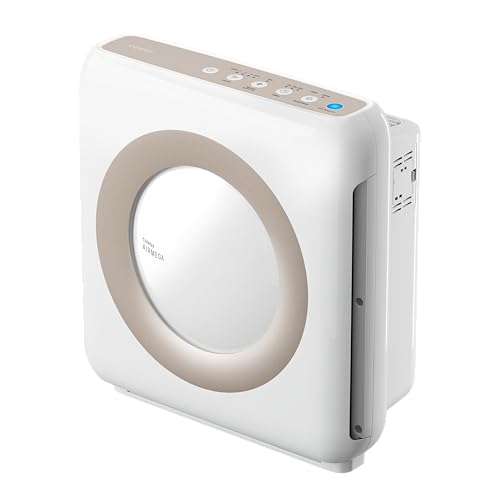 Buy theCoway Airmega Mighty AP-1512HH
if any of these is you:
- The room is between 21 and 35 m²
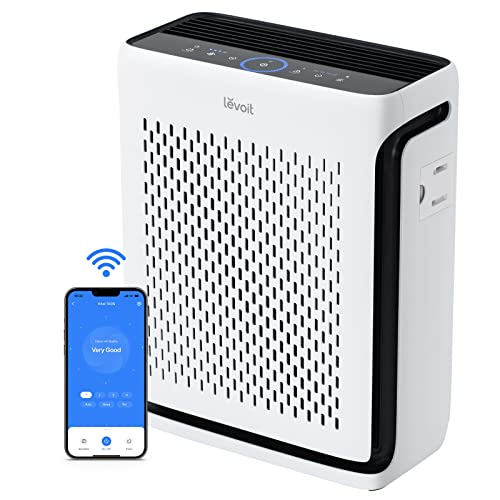 Buy theLevoit Vital 100S
if any of these is you:
- You want to check and set it from your phone
 Buy theCoway Airmega 100
if any of these is you:
- The room is 20 m² or smaller
- You want to spend under $150
What we look for in a budget air purifier
Clean air for the money
The clean-air rate decides how big a room a purifier can look after, so it's where the money should go first. In our under-$150 band the stated rates run from 55 to 244 m³ an hour, and in the $150 to $300 band they run from 112 to 443.
Read the explainer →A room size you can trust
The room size printed on a box isn't worked out the same way from one brand to the next, which makes boxes hard to compare. So we divide every purifier's clean-air rate by 12, and the answer is the room it can clean five times an hour. It's often a good deal smaller than the box suggests.
The filter and how long it lasts
Even an inexpensive purifier needs a new filter now and then, and the rated life varies quite a bit. We check what kind of filter it is, whether there's a carbon layer for smells, and how many months it's rated for. Two of these picks are rated for 12 months and one for 8.
Read the explainer →Extras that save effort
A particle sensor with an auto mode lets the purifier choose its own speed, which means one less thing for you to manage. All three picks have both. A phone app is pleasant to have as well, though it comes after the clean-air rate.
The three side by side
| Best overallCowayAirmega Mighty AP-1512HH | Best with a phone appLevoitVital 100S | Best under $150CowayAirmega 100 | |
|---|---|---|---|
| Price band | $150 to $300 | $150 to $300 | Under $150 |
| Clean air an hour | 421 m³ | 243 m³ | 244 m³ |
| Room it cleans 5 times an hour | 35 m² | 20 m² | 20 m² |
| Carbon layer for smells | Yes | Yes | Yes |
| Particle sensor | Yes | Yes | Yes |
| Noise | 24.4 to 53.8 dB | 23 to 52 dB | 20 to 48 dB |
| Filter lasts | 12 months | 8 months | 12 months |
| View price | View price | View price |
What each costs to run
Set the two boxes to match your home and the costs below update.
The electricity figure assumes full power for every hour, so it is the most you would pay. A purifier on a low fan speed uses less. Filter costs use the price of the replacement filter when we checked in November 2026, so treat them as a guide.
Our three picks, reviewed
A living room is the hardest room to cover on a budget, simply because it’s usually the biggest room in the house, and that’s why the Airmega Mighty comes first here. A 35 m² room needs 35 × 12 = 420 m³ of clean air an hour, and the Mighty delivers 421. That’s the second-highest rate in our $150 to $300 band, and 35 m² takes in a good-sized living room.
It also asks very little of you once it’s set up. A particle sensor runs an auto mode that sets the fan speed, and a light in three colours tells you how the air is doing. When the air has been clean for 30 minutes, the eco mode stops the fan until it’s needed again, and there’s a timer for 1, 4 or 8 hours if you’d rather decide yourself.
The air passes through a washable pre-filter, a deodorisation filter with carbon and a GreenHEPA filter, and an ioniser makes a fourth stage. There are two filters to keep track of, because the main filter is rated for 12 months and the deodorisation filter for 6. On its lowest speed it runs at 24.4 dB, rising to 53.8 dB at full speed.
What you give up is a little economy and a little portability. It draws 82 W, where the Levoit below draws 32 W and the Airmega 100 draws 25 W, and at 5.9 kg it’s a purifier you’ll set down in one room and leave there. If your room is 20 m² or smaller you’d be buying more air than the room can use, and the Airmega 100 further down covers that size from one price band lower.
The Vital 100S delivers 243 m³ of clean air an hour, which is almost exactly what the Airmega 100 below delivers from a cheaper band, so on air alone it wouldn’t be in this guide. It’s here for what it adds, which is a phone app. Of our three picks, this is the only one where we could confirm an app.
An app can sound like a small thing, so here’s what this one gives you. You can check the purifier and change its settings from another room, which is handy when it’s running in a bedroom where someone is asleep. It holds a pet mode that you won’t find on the machine’s own buttons, and it works with Alexa and Google Assistant if you already use either of those at home.
The size is the same story as the Airmega 100. A 20 m² room needs 20 × 12 = 240 m³ an hour, and with 243 on offer, 20 m² is as large as this purifier should go. That covers a main bedroom, a study or a small lounge. Like the two Coways it has a particle sensor and an auto mode, so it will pick its own fan speed as the air changes.
Bedrooms are where it’s most at home, and one small feature shows that. A light sensor turns the display off when the room gets dark, so you don’t have to remember to do it yourself, and the lowest fan speed runs at 23 dB.
The filter is where it asks a little more of you than the others. It’s rated for 8 months, against 12 for both Coways, which works out to three filters every two years where the Coways need two. So if an app isn’t something you’d use, the Airmega 100 gives you the same air for less, with a filter that lasts longer.
It’s easy to assume that our cheapest band only holds purifiers for very small rooms, and the Airmega 100 is a welcome exception. It delivers 244 m³ of clean air an hour, which is the highest stated rate in our under-$150 band. Divide 244 by 12 and you get a little over 20, so it can clean the air of a 20 m² room five times an hour. That’s a main bedroom or a small lounge, and not only a nursery.
What makes it good value is how much of the bigger Mighty’s design has been kept. A particle sensor runs an auto mode, so the fan speeds up and slows down as the air changes, and there are three speeds to choose from when you’d like to set it yourself. A light in four colours shows the state of the air. The filter is a True HEPA H13 behind a pre-filter, with a deodorisation filter that contains carbon for smells, and it’s rated for 12 months.
It’s a comfortable purifier to have in a bedroom as well. Its lowest speed runs at 20 dB, which is the quietest of our three picks, and it has a night light and a timer for 1, 2, 4 or 8 hours. It draws 25 W, the least of the three, and at 3 kg it’s easy to carry to whichever room needs it.
Its limit is the 20 m² we worked out above, and for anything larger the Mighty is the one to look at. We also couldn’t confirm whether it has a phone app, so if you’d like to check on your purifier from your phone, the Vital 100S is the safer choice.
Common questions
What do you give up by spending less? Mostly it’s room size. The biggest purifier in our two cheapest bands can clean a 36 m² room five times an hour, so if you have an open-plan floor larger than that, you’ll need to look one band up. Our smoke guide has two picks that go further.
Is the filter in a cheap purifier a lesser one? Not as a rule, and it’s a reassuring thing to know. The filter grade and the price are separate matters, and our under-$150 pick here has an H13-grade filter. What you get less of in a cheaper purifier is air passing through the filter each hour. If the labels are confusing, our explainer on HEPA grades goes through what they mean.
What does one cost to run? Not much in power. A purifier’s draw is given in watts, and multiplying by 24 tells you what it uses in a day if it never stops. For the Airmega 100 that’s 25 × 24 = 600 watt-hours, or 0.6 kWh, and for the Mighty drawing 82 W it’s about 2 kWh. The “What each costs to run” section on this page turns those into a yearly figure for you. New filters are the bigger cost over the years, which is why we list each filter’s rated life.
Our verdict
A cheap purifier is only good value if it's big enough for the room, so the place to begin is with the clean air your room needs, which is the floor area multiplied by 12. Once you have that figure, the least expensive purifier that reaches it is usually the right one, and there's no need to buy more than that.
It's worth a thought for what comes after the day you buy it, too, because filters and power are the costs that carry on. A filter rated for 12 months and a low power draw can matter more over a few years than a small difference in price.


