What is CADR, and how much do you need?
Shopping for an air purifier means meeting a lot of numbers, and the one most people reach for first is the room size printed on the box. That figure is less helpful than it looks, because each brand works its room size out in its own way. CADR is the number underneath it, and it tells you how much clean air actually comes out of the machine. Once you know what it means, a single multiplication will show you whether a purifier is big enough for your room, and we'll go through it together here.
Published November 2026
CADR is the clean air that comes out
A purifier is really two parts working together, a fan that moves the air and a filter that cleans it. Neither is much use without the other, so what you want to know is how much air has been through both by the time it comes back into the room. CADR is the figure for exactly that. The letters stand for clean air delivery rate, which is the volume of filtered air a purifier returns to the room in a given time. Australian spec sheets give it in cubic metres an hour, and in our tables we simply call it “clean air an hour”.
The US EPA’s guide to air cleaners explains what the figure is for: the higher the CADR, the more particles a purifier can filter and the larger the area it can serve. It’s an honest measure because one good part can’t flatter it. A fine filter behind a weak fan gets a low figure, and so does a strong fan pushing air past a leaky filter, so the number rewards the two working well together.
If you’re reading an American spec sheet you’ll see cubic feet a minute instead, and that’s easy to convert. Multiply by 1.7, so 100 cubic feet a minute is about 170 m³ an hour.
Turning CADR into a room size
A clean-air figure doesn’t mean much until you set it against a room, because the same purifier is generous in a study and stretched in a lounge. So the helpful question is how many times in an hour it could pass all the air in your room through its filter. That’s called air changes an hour, and working it out takes two small steps.
First find out how much air the room holds, which is the floor area multiplied by the ceiling height. A bedroom that’s 3 m by 4 m has 12 m² of floor, and under a 2.4 m ceiling that makes 12 × 2.4 = 28.8 m³ of air. Then divide the purifier’s clean air by that volume. A purifier that delivers 144 m³ an hour would give this bedroom 144 ÷ 28.8 = 5 air changes an hour.
The five air changes are a rough guide from the CDC
We give every purifier on this site a room size by the same rule, which is the biggest room where it manages five air changes an hour under a 2.4 m ceiling. You might reasonably ask why five, and the answer deserves a little care.
The figure comes from the US CDC, whose ventilation guidance suggests aiming for 5 or more air changes an hour of clean air. That guidance is about reducing virus particles in a room, and the CDC itself calls it a rough guide and not a hard rule. It wasn’t written as a rule for dust, pollen or smoke, and we don’t claim it is one. We use five because it’s a published figure, and because holding every purifier to one bar makes them easy to compare.
Happily, it also makes the arithmetic very short. Five changes an hour under a 2.4 m ceiling comes to 5 × 2.4 = 12 m³ of clean air for each square metre of floor. So you can multiply your floor area by 12 to find the clean air your room needs, or divide a purifier’s figure by 12 to find the biggest room it can look after.
It’s reassuring that the EPA’s own sizing table for particles lands in nearly the same place. For a 100 square foot room with an 8 foot ceiling it gives a minimum CADR of 65 cubic feet a minute, which is about 110 m³ an hour for 9.3 m² of floor, or a little under 12 m³ for each square metre.
Why the room size on the box is so much bigger
Here’s how that looks with a real machine. The Levoit Core 300 delivers 187 m³ of clean air an hour, and 187 ÷ 12 is a little over 15, so once we round down the room size we show for it is 15 m². In the 12 m² bedroom from earlier it would give about six and a half air changes an hour, which is comfortably more than five.
The room size advertised for the same purifier is 40 m², and that can look like a contradiction until you work it through. In a room that large it would change the air about twice an hour. Neither figure is wrong. They answer different questions, because each brand chooses its own number of air changes when it prints a room size.
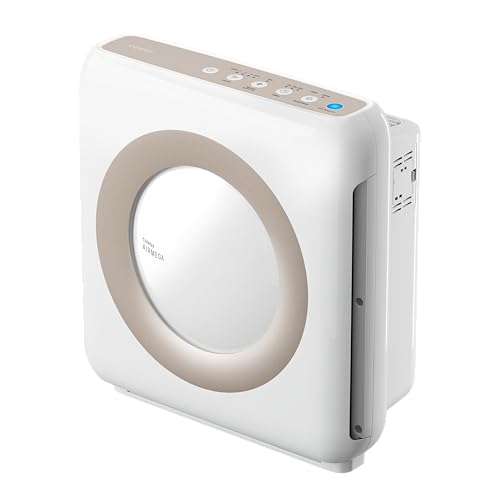
You’ll find the same gap on bigger machines too. The Coway Airmega Mighty delivers 421 m³ an hour, which makes it a 35 m² purifier by our rule, while its advertised room is 109 m², where it would give about 1.6 air changes an hour. This is why we set the box figure to one side, start from the clean air, and work out every room the same way.
Three things CADR leaves out
CADR is normally measured at full speed, and that matters when you think about nights. The EPA’s guide notes that a purifier filters less air at a lower speed, so the quiet setting you’d leave on while you sleep moves less air than the headline number.
It’s also a figure about particles. The same guide describes the CADR rating system as being for particles only, which means it says nothing about gases and smells. Those are a job for a carbon layer, and we cover that in HEPA grades explained.
Lastly, our room sizes assume a 2.4 m ceiling. If yours is higher there’s more air in the room, so the same purifier will give fewer changes an hour than our figure suggests.
Multiply your floor area by 12
Measure the floor, multiply by 12, and look for a purifier with that much clean air an hour or more. A 10 m² study needs 120 m³ an hour and a 50 m² open-plan space needs 600. For a 30 m² living room it’s 30 × 12 = 360 m³, and the Airmega Mighty, at 421 m³ an hour, has clean air enough for a room that size.
If your ceiling is higher than 2.4 m, or you’d simply like the working done for you, our Room Sizer will do it. It lists every purifier that’s big enough, cheapest price band first. You can also see the clean air of every model side by side on the air purifiers page.
And if you find yourself hesitating between two sizes, going one up is no bad thing. A bigger purifier reaches five changes without running flat out, and a slower fan is a quieter one.