What does litres a day mean on a dehumidifier?
Litres a day is the big number on every dehumidifier box, and it's reasonable to assume that a bigger number means a stronger machine. Often it does. What the box doesn't make obvious is that the figure was measured in a test room kept at one particular temperature and humidity, and brands don't all choose the same room. So the number to read is really two numbers, the litres and the room they were measured in, and with both in hand you'll have a much better idea of what will end up in the tank at your place.
Published November 2026
The figure comes from a test room
To get the figure, a manufacturer runs the machine in a closed room and measures the water it collects. The room is held at a set temperature and a set humidity for the whole test, and the result is given as litres over 24 hours.
That makes it a true measure of that machine in that room. What it can’t tell you is how much water will be in the tank after a day in your bedroom, because your bedroom is a different room, and as we’re about to see, the room makes a very large difference.
The same machine scores differently in a different room
The clearest way to see this is with a dehumidifier that has been rated twice, and the Breville Smart Dry Connect is one. In a test room at 30°C and 80% humidity it’s rated at 10 litres a day. In a second test, at 27°C and 60% humidity, the same machine is rated at 5 litres a day.
Nothing about the machine changed between those two tests. The room got a little cooler and a good deal drier, and the figure halved.
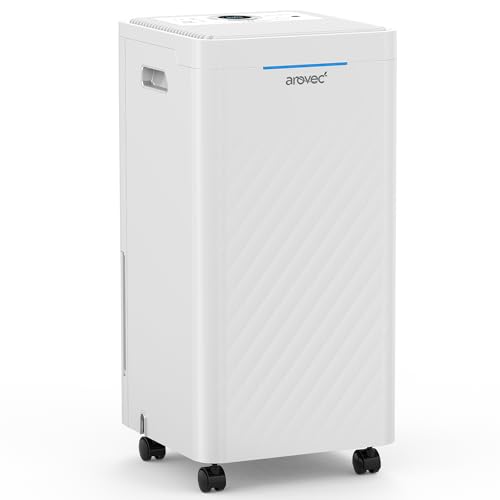
It isn’t a quirk of one model, either. The Arovec AroDry-P16 also carries two ratings, which are 16 litres a day at 30°C and 80% humidity and 8 litres a day at 27°C and 60% humidity.
Warm, damp air gives a bigger number
A dehumidifier can only collect water that’s in the air to begin with, and warm air can carry far more of it. The Australian Building Codes Board’s condensation handbook explains that temperature sets the most water vapour that air can hold. So air at 30°C and 80% humidity holds much more water than air at 20°C and 60% humidity, and a machine working in the first room simply has more to collect.
The three test rooms you’ll come across
Three test rooms cover most of the machines in our list, and it helps to recognise them.
- 30°C and 80% humidity. Most compressor machines use this room. It’s hot and very damp, so it gives big figures.
- 20°C and 60% humidity. The desiccant machines in our list use this room, which is closer to a house in winter.
- 35°C and 90% humidity. Hotter and wetter again, and only one machine we list uses it: the Philips Series 3000, which is rated at 34.3 litres a day there.
Test rooms differ between countries as well. In the United States, the government test for portable dehumidifiers moved from 80°F to 65°F in 2019, which is from about 27°C down to about 18°C. A machine tested the new way will likely report a smaller figure than it did under the old test.
Now and then you’ll meet a litres-a-day figure with no test room beside it at all. There’s nothing wrong with the machine for that, but a figure like that can’t be compared with anything, so we don’t try.
A bigger number from a different room isn’t a bigger machine
Here’s where reading the test room saves you from a wrong conclusion. The Ionmax Vienne ION630 is a desiccant machine rated at 10 litres a day at 20°C and 60% humidity. Put that beside a compressor machine rated at 20 litres a day at 30°C and 80% humidity and the compressor looks twice as strong, yet the two machines never worked in the same room.
Remember how far the Breville’s figure moved. Its 10 litres became 5 when the room dropped to 27°C and 60% humidity, and the Vienne’s test room is cooler again. There’s no simple conversion from one test room to another, which is why we only ever compare litres between machines tested in the same room.
Inside one test room, you can compare as much as you like. The Vienne’s 10 litres can be set against the Ionmax ION610’s 6 litres, because both were measured at 20°C and 60% humidity.
What to expect from the tank at home
Most rooms at home are cooler and drier than 30°C and 80% humidity, so a compressor machine will collect less water there than its headline figure. That isn’t a fault, it’s just the room. If the machine has a second rating at 27°C and 60% humidity, that figure is the better guide to what you’ll see.
In a cold room, the type of machine matters more than the litres, and our compressor or desiccant explainer covers that choice. Our Room Sizer takes the same view, which is why it goes by each manufacturer’s room size and asks whether the room gets cold in winter.
Whichever machine you end up with, you’ll find the tank fills more slowly once the machine has done its job, and that’s a good sign. The US Environmental Protection Agency advises keeping indoor humidity below 60%, and ideally between 30% and 50% humidity. A machine with a humidity target stops when the room reaches the setting, so a tank that fills slowly in a dry room means the machine is working, and the litres on the box have done their job.