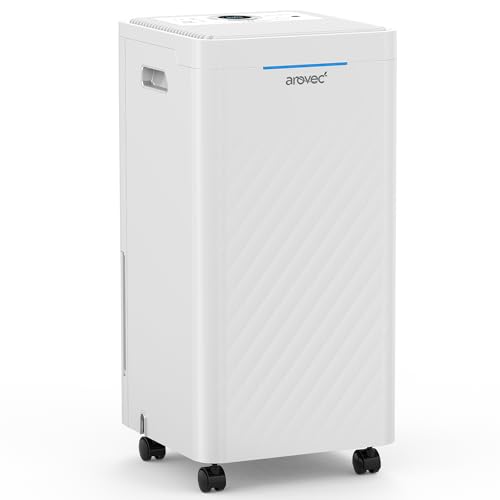
Compressor or desiccant: which dehumidifier do you need?
Start comparing dehumidifiers and you'll notice that the full-size ones come in two kinds, compressor and desiccant, and that the boxes rarely explain the difference. It's simpler than it sounds. One kind chills the air until the water drops out of it, and the other soaks the water up with an absorbent material. Which one you need mostly comes down to how cold your room gets in winter. After that it's a matter of power, noise and how easy the machine is to carry.
Published November 2026
A compressor machine chills the water out of the air
If you’ve ever taken a cold bottle out of the fridge and watched it bead with water, you’ve seen how a compressor dehumidifier works. Inside is a set of coils kept cold in the same way a small fridge is, and a fan pulls room air across them. The air cools, the water in it turns to drops on the coils, and the drops run down into the tank.
Doing that job on modest power is the main strength of the kind. The Breville Smart Dry Plus Connect draws 320 W, and in its test room at 30°C and 80% humidity it’s rated at 20 litres a day.
Those cold coils are the thing to remember as you read on, because they’re also the reason a compressor machine has a hard time in a cold room.
A desiccant soaks the water up instead
A desiccant dehumidifier has no cold coils at all. It passes room air over a material that absorbs water, and then a heater inside the machine dries that material out so it can be used again. The water ends up in the tank just the same.
Because nothing inside it has to be cold, a desiccant carries on working when the room is. The Ausclimate Cool-Seasons Premium 10L, for example, runs in rooms from 1°C up to 40°C.
Its 10 litres a day was measured at 20°C and 60% humidity, which is a cooler and drier test room than the Breville’s. That means the two litres figures can’t be ranked against each other, and our litres a day explainer sets out why.
Cold rooms are where a compressor struggles
The US government’s Energy Star program warns that frost can form on the coils once the air drops below 65°F, which is about 18°C. When that happens the compressor cycles on and off without removing much water. Energy Star’s advice for rooms that are usually colder than that is to buy a machine made for lower temperatures.
A desiccant has no coils to frost, and the desiccant machines we list work from 1°C. The compressor machines that publish a range do reach down to a few degrees above freezing as well, but that lower limit only tells you where the machine will still run, and the frost Energy Star describes can begin well above it.
So the rule of thumb is a friendly one. For a living room, a heated bedroom or a laundry that stays mild, a compressor machine is the one to buy. For an unheated bedroom, a garage or a holiday house in a southern winter, choose a desiccant.
A desiccant’s heater costs more to run
The heater that lets a desiccant work in the cold is also what makes it draw more power, and you can see the difference in two machines sold for the same size of room. The Ausclimate and the Breville above are both recommended by their brands for rooms up to 50 m². The Ausclimate draws 730 W and the Breville draws 320 W.
That gap is the usual pattern, although a very large compressor machine can draw as much as a desiccant does.
Both kinds also put some warmth back into the room. Energy Star notes that a dehumidifier slightly warms the space around it as it works, and a desiccant, with a heater inside it, gives off rather more. That’s welcome in a cold bedroom and much less so in a Queensland summer.
What this means for your choice is that a compressor machine will cost less to run wherever the room is warm enough for one. A desiccant earns its extra power when the room is cold for a good part of the year, and not otherwise.
Noise is mixed, but a desiccant is lighter to carry
It would be handy if one kind were always the quiet one, but noise doesn’t divide that neatly. The Ionmax ION610, a desiccant, runs at 34 dB on its low fan setting and 45 dB on high. The Breville compressor machine above gives a single figure, which is 48 dB.
Across our list the two kinds overlap, so the type won’t tell you much. Look at the figures for the machine you have in mind, and check which fan setting each one describes.
Weight is a different story, because a compressor is a heavy part. The Ausclimate weighs 6.8 kg and the Breville weighs 13.5 kg, and the compressor machines in our list are the heavier ones as a rule. If you plan to carry one machine between a bedroom and a laundry, a desiccant will be kinder on your arms.
Mini units are for cupboards, not rooms
You may also have seen the small units sold for wardrobes and cupboards, and they’re a third kind altogether. They use an electric cooling plate with no compressor, which makes them light and usually quiet, and it also means they collect very little water.
The Arovec AroDry-900 gives you the scale. At 30°C and 80% humidity it collects 0.3 litres a day, on 22.5 W. The Breville Smart Dry Connect, one of the smaller compressor machines we list, is rated at 10 litres a day in the same test room, and 10 ÷ 0.3 is about 33 times as much water.
So a mini unit is a good fit for a closed cupboard or a wardrobe, but it’s too small for a damp bedroom, and since 0.3 litres is already a full day’s work, leaving it on longer won’t close the gap.
For a whole room, then, the choice comes back to where we started. Our Room Sizer asks whether your room gets cold in winter for exactly this reason, and the dehumidifiers page shows which kind each machine is. If the room is heated or stays mild, a compressor machine will do the job for less, and if you can see your breath in there on a July morning, it’s a desiccant you want.